Building a Claude and Obsidian Second Brain
Mr. Buzzoni describes a $20 Claude Pro setup using Opus 5.5 as a librarian, based on two papers, and outlines four ways to monetize it.
textMr. Buzzoni (@Mr_Buzzoni) · Oct 28, 2026 · x.com · Saved Oct 28, 2026
personal knowledge management, obsidian, claude
the full build on a $20 Claude Pro plan: opus 5.5 as the librarian, the two october papers behind it, every file and command, and four ways to get paid for it
Every Claude session starts the same way. You paste the context, explain the project again, point it at the files that matter, and twenty minutes later it knows what it knew yesterday. Then the window closes and all of it is gone.
The industry's answer has been memory layers: tools that decide what to remember before you ask anything. I tried a few. They remembered the wrong things with great confidence.
Two papers from October changed how I think about this. One, from Shanghai Jiao Tong, put memory layers against plain history plus search, with Claude Opus 5.5 among the readers.

The other, from Stanford, trained an agent to organize raw documents into a library of linked files before any question arrives. Both land in the same place, and it's something a lot of you already have open: a folder of markdown files that link to each other.
That's an Obsidian vault. Andrej Karpathy described the pattern in his llm-wiki idea file in one line: "Obsidian is the IDE; the LLM is the programmer; the wiki is the codebase."
On October 21 Anthropic opened a research preview of Claude Duet, an app where Claude works as a proactive agent and keeps working when you step away. An agent that works while you're gone needs somewhere to keep what it learns. This article is the build for that place.
Opus 5.5 is the librarian, three cheaper workers sit around it, and the whole thing runs on the $20 Claude plan plus about $1.26 a month. The last section is the part most second brain guides skip: four ways to get paid for it.
1/ TWO PAPERS, ONE ANSWER
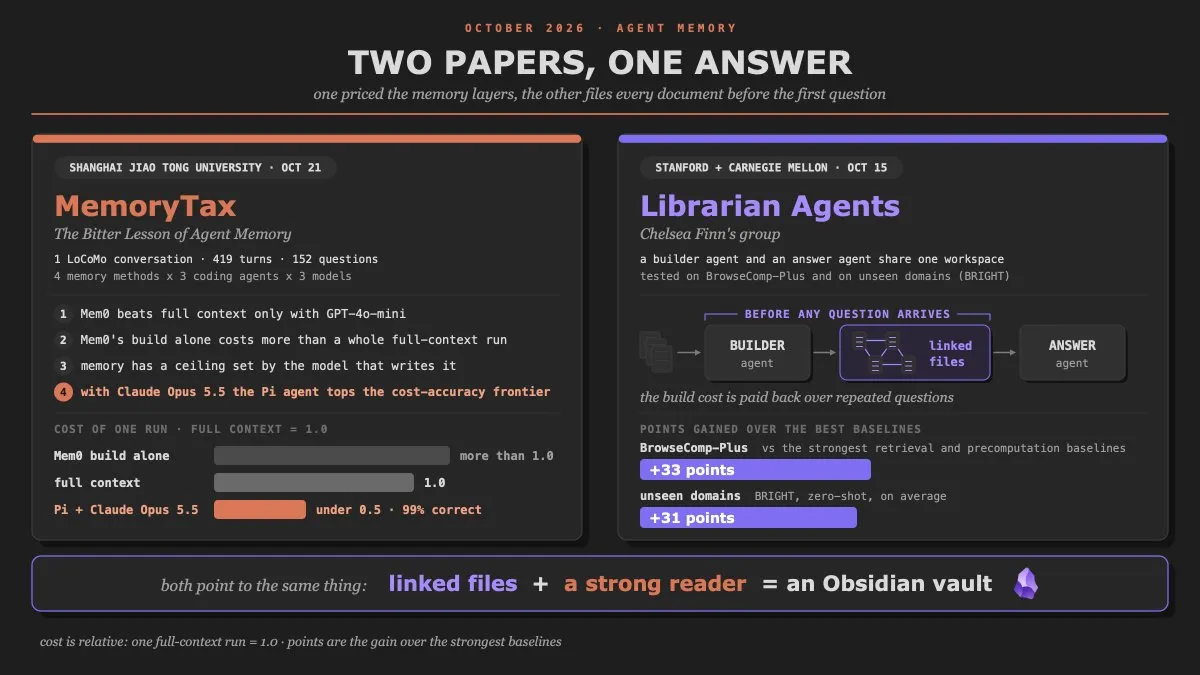
MemoryTax asked a blunt question: once the model is strong enough to search for itself, does designed memory still help?
The authors ran one long conversation, 419 turns and 152 questions, through four memory methods and three coding agents, with three models as the reader, Claude Opus 5.5 among them.
Librarian Agents came at it from the other side. A builder agent reads raw documents first and turns them into a hierarchy of files with reference links. Questions come later, and an answering agent works from that prepared workspace.
Three lessons fall out of these results, and the whole build below follows from them.
Memory is only as good as its writer. MemoryTax found a ceiling: a stronger reader can't recover what a weaker writer left out. So the pages get written by your strongest model.
Organize before anyone asks. The Stanford builder did the expensive thinking once, ahead of time, and every later question got cheaper and better. That's a librarian, working on a schedule.
Keep it in plain files the model can search. Both winners were agents reading files, with no opaque store in between. Obsidian is a folder of markdown with links, so you and the agent read the exact same thing.
2/ THE VAULT
Install Claude Code and sign in once:
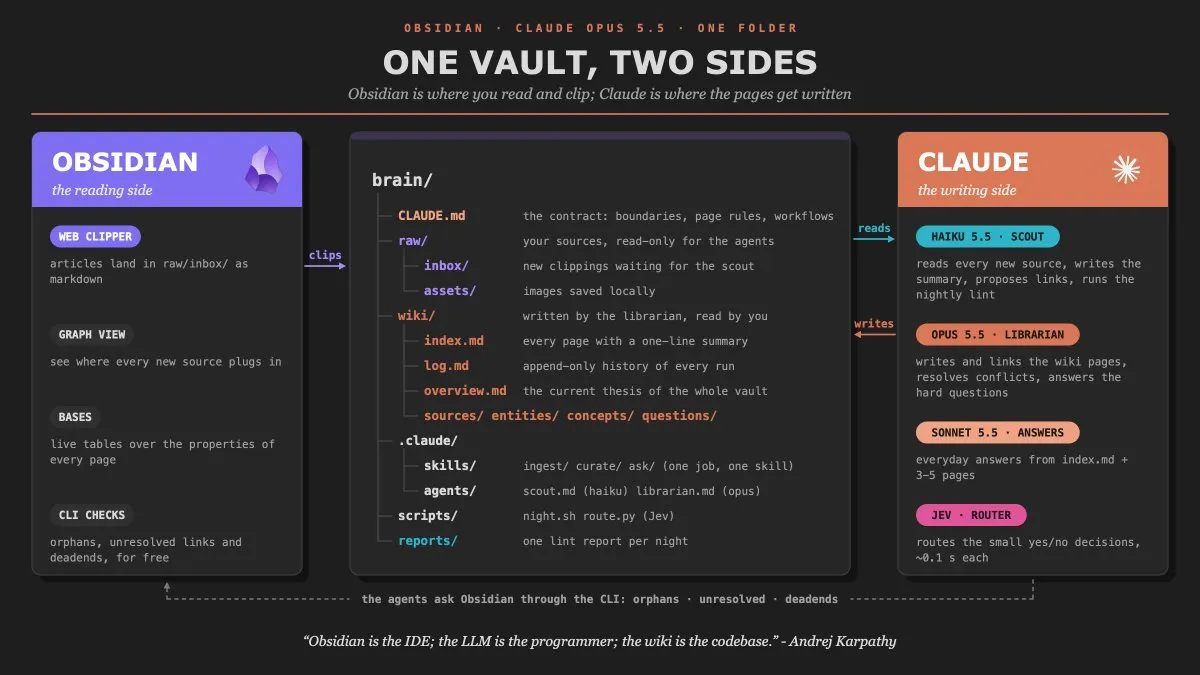
Create the vault. Make a folder called brain, open it as a vault in Obsidian, and give it this shape:
Turn on the Obsidian CLI. Since version 1.12.7 Obsidian has a command line that talks to the running app. Enable it in Settings -> General -> Command line interface. The agents can now ask Obsidian which pages have no incoming links and which links point nowhere, for free and in milliseconds.
Point the Web Clipper at the inbox. Set the Obsidian Web Clipper's default folder to raw/inbox/, and set attachments to raw/assets/ in Settings -> Files and links. Every article you clip lands where the scout looks for work.
Start Claude Code inside the vault. Run claude from the brain folder and keep Obsidian open beside the terminal. Pages appear and links form in the graph view while you watch.
3/ CLAUDE.md, THE CONTRACT
Karpathy calls the schema file the thing that turns a general chatbot into a disciplined maintainer. In this build it's CLAUDE.md, which Claude Code reads at the start of every session. Boundaries go first, because everything you clip from the web is untrusted text.
The line about instructions inside a source earns its place. A paper from NUS (From Approval to Abuse, Oct 16) planted instructions in repositories and got coding agents, Claude Code included, to request dangerously broad permissions in 58% of runs.
When a user approved, the attack finished in 81% of cases. A vault full of clipped web pages is exactly that kind of input, so back the rule with hard limits in .claude/settings.json:
And when Claude Code proposes a new "always allow" rule mid-run, read it twice before you click.
4/ FOUR WORKERS, ONE LIBRARIAN
Using Opus 5.5 for everything works, and it's the most expensive way to run a vault. Most of the work is reading, sorting and checking, which a smaller model or a decision model does well at a fraction of the price. The writing stays with Opus, because of the ceiling MemoryTax found.
The two Claude workers are subagents. Each one is a file in .claude/agents/:
Jev sits in a small script and answers the yes-or-no forks in about a tenth of a second. Here it spots duplicate sources and decides which questions need the librarian:
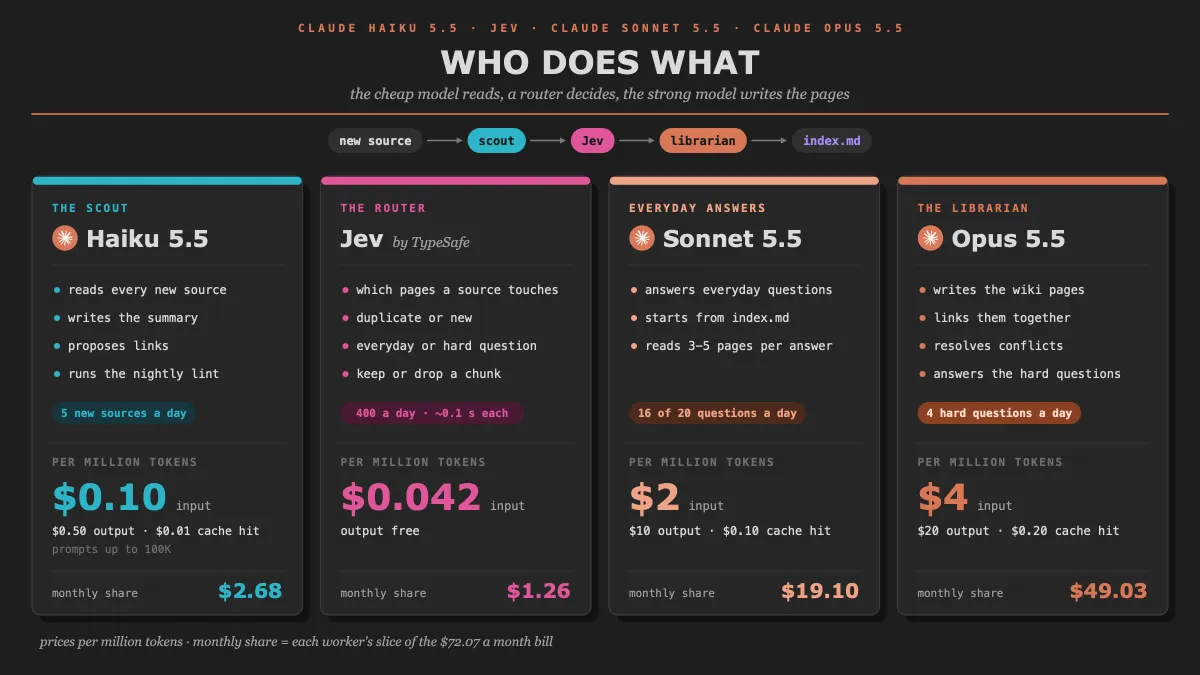
Anything Jev isn't sure about goes up to Opus. A wrong guess costs you a few cents, and the everyday questions never touch the most expensive model.
5/ THREE SKILLS, ONE JOB EACH
Skills are where vaults break without telling you. A USC paper (One Skill Takes Over, Oct 18) loaded two skills written for the same job into one agent.
Each skill's rules were followed 93-99% of the time on its own and 61-62% with a rival skill next to it, because one skill simply takes over. A single merged file, written by Claude Opus 5.5, brought all seven models back to 96-99%.
So the rule here is one job, one skill, three skills total. Never install a second "ingest" skill from someone else's repo next to yours. Merge it into yours.
The other two follow the same shape. curate runs the librarian over everything logged since the last curate. ask runs scripts/route.py, then sends the question to Sonnet 5.5 or the librarian and files any answer worth keeping into questions/.
6/ THE NIGHT SHIFT
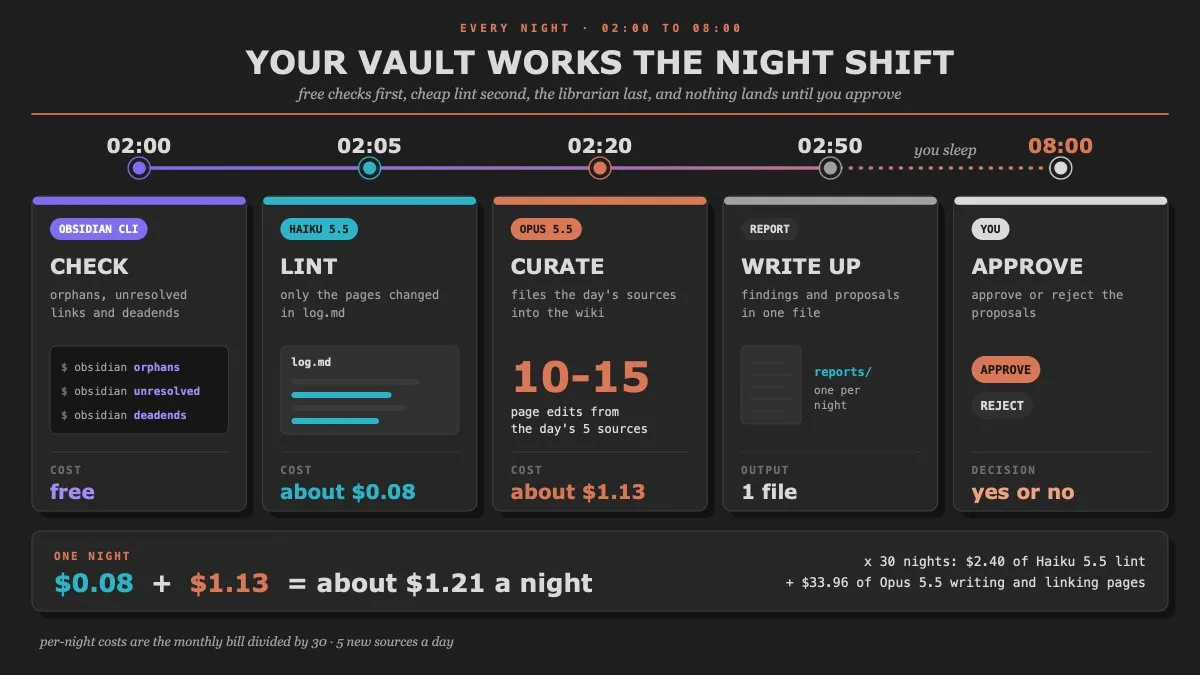
The Stanford result is about doing the organizing before anyone asks. In a vault that means a night shift, run with cron and Claude Code's headless mode.
At 08:00 you open reports/ with your coffee, approve the fixes you agree with and reject the rest. That's the whole daily cost to you: about five minutes of reading.
7/ THE BILL: $21 OR $72
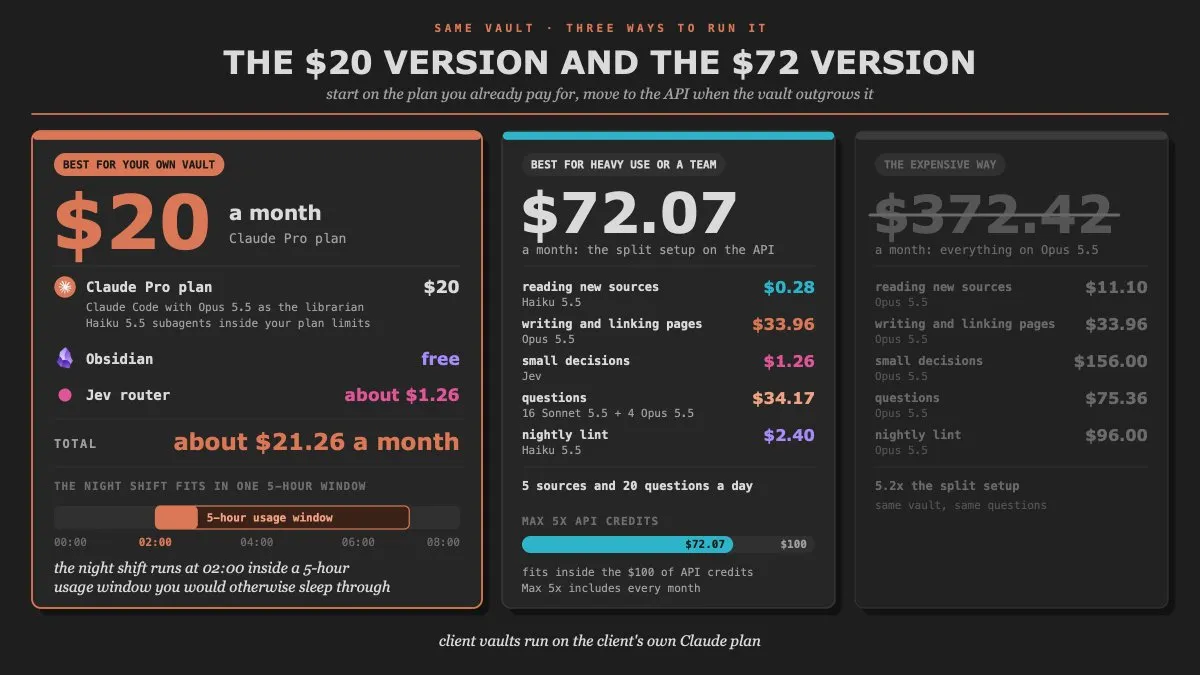
The $20 version. Claude Pro includes Claude Code, so the librarian, the scout and the night shift all run inside the plan you already pay for. Obsidian is free. The only extra line is Jev, about $1.26 a month for 400 decisions a day. That's $21.26 a month for a vault that organizes itself.
Pro usage resets in 5-hour windows, and the night shift runs at 02:00, inside a window you'd otherwise sleep through. If a heavy day hits the cap, let the scout finish at night and run the librarian over lunch.
The API version is for heavy use or a whole team: 5 new sources a day, 20 questions a day of which 4 are hard, a vault of about 500 pages or 750,000 tokens, and around 400 small decisions a day. Prices come from Anthropic's pricing page and TypeSafe.
The librarian's line is the same in both columns on purpose. The writing is the part worth paying for, and everything around it drops from about $338 to about $38.
Cache hits on Opus 5.5 cost $0.20 per million tokens against $4 fresh, so keep CLAUDE.md and index.md at the top of every prompt.
And if you're on Max 5x, the $100 of API credits it now includes every month covers the API version with room to spare.
8/ HOW TO MAKE MONEY WITH IT
The gap is simple. Consultants, analysts, investors and founders drown in documents, and the second brain guides they find all end with "now you have a vault". Very few people can set one up that maintains itself. You can, for $21 a month, and the build above is the proof you can show them.
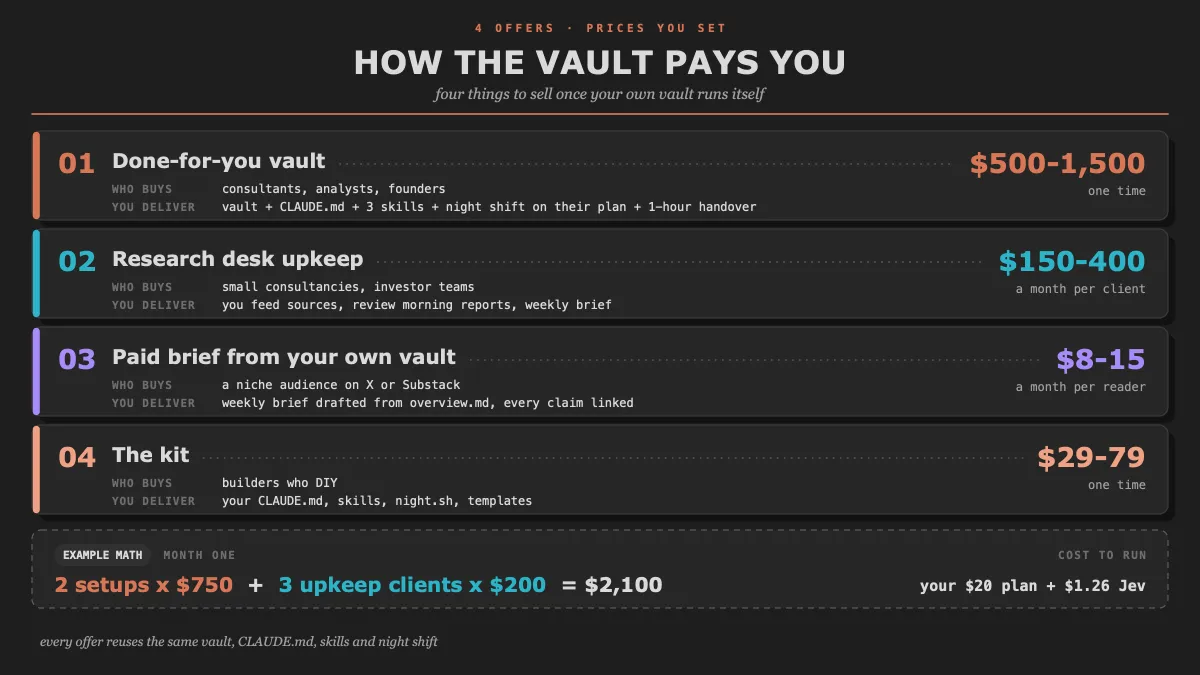
Four offers, from fastest cash to slowest. The prices are where I'd start, so set your own.
Example math for a first month: 2 setups at $750 and 3 upkeep clients at $200 come to $2,100. Your running cost stays at your own $20 plan plus Jev, because every client vault runs on the client's own Claude plan. That keeps you inside Anthropic's terms.
The 7-day plan to the first client:
- Days 1-3: build your own vault on a topic your buyers care about, their industry, their competitors, their regulation. Clip 15-20 sources.
- Day 4: record 60 seconds of the graph view growing and one morning report. That clip is your portfolio.
- Day 5: post the clip with what the vault found that a person would have missed.
- Days 6-7: send 20 short messages to people in that niche, with the report attached.
And the slow money: your job. Run the same build on your team's docs, tickets and meeting notes. The person who answers "why did we decide that?" in seconds, with a link to the decision, is the person who gets handed the next big project, and that's where raises come from.
THE SHORT VERSION
A second brain is a folder of linked files and a strong model that writes them.
Opus 5.5 writes, Haiku 5.5 reads and checks, Sonnet 5.5 answers the easy questions, Jev routes everything in between.
The organizing happens at night, and the whole thing runs on a $20 Claude plan plus about $1.26.
Then you sell it: setups, upkeep, a paid brief or the kit.
Start tonight: install Claude Code, make the brain folder, paste the CLAUDE.md above, clip three articles you care about and type "ingest".

The stack:
📁 Obsidian
📁 Claude Code
↳ https://code.claude.com/docs
📁 Karpathy's llm-wiki idea file
↳ https://gist.github.com/karpathy/442a6bf555914893e9891c11519de94f
📁 MemoryTax paper
↳ https://arxiv.org/abs/2610.29823
📁 Librarian Agents paper
↳ https://arxiv.org/abs/2610.22273
📁 Jev by TypeSafe
↳ https://docs.typesafe.ai/api
And if you found this useful:
- Bookmark this article. The links change and new repos pop up weekly, you'll need this as a reference
- For weekly deep dives into AI architecture, quant trading, and the agent economy, follow me: @Mr_Buzzoni
- here I share my raw prompts, custom skills, and alpha that's too early for XJoin the TG Channel: Buzzoni Notes