
S03E02 · Translating Intent into Agent Work: MEGA lesson
MEGA’s written lesson explains how to guide agents with intent, principles, product context, clear work agreements, and evaluation criteria. It discusses approaches from Kent C. Dodds, Matt Pocock, Lauren Tan, and Joel Hooks.
textMEGA · hq.mega.dev · Saved Nov 19, 2026
mega course, context engineering, agent prompting, evaluation design
Written lesson S03E02 of the MEGA.dev course, by MEGA. Agenda: Intent · Context · Requirements · Specifications · Decomposition · Evaluation. Its lesson video is presented by Kent C. Dodds and saved separately. (MEGA Student HQ, needs a login.)
S03E02 · Translating Intent into Agent Work
Agents can move really fast, but they need to know where they're heading, without us having to answer their every question or watch their every move, and without sacrificing quality or the proper shape of the product. Getting all of this without even having to read the code sounds like wishful thinking. But is it really?
Despite their technical limitations, generative models possess capabilities that exceed much of what we can do, and this single fact is the core concept we need to grasp. But instead of worrying that we will become obsolete, it's better to focus on figuring out how we can use these capabilities. And there are lots of things to explore.
Just think for a second: if we have an agent more capable than us, instead of telling it how to do things, we need to tell it what we need, what principles (not rules) to follow and how to prove the result is aligned with them.
But how can we do this, exactly?
Outline
- Intent: definition of done, user impact, existing behavior, desired outcome
- Context: product knowledge, market knowledge, codebase maps, constraints, conventions, prior decisions
- Requirements and decomposition: assumptions, ambiguities, contradictions, missing information, focused questions, structured briefs, negative examples, boundaries, simplification, dependencies, checkpoints, rules, assignments, open-endedness
- Evaluation: expectations, acceptance criteria, quality bars, evidence requirements, tests
Describing intent
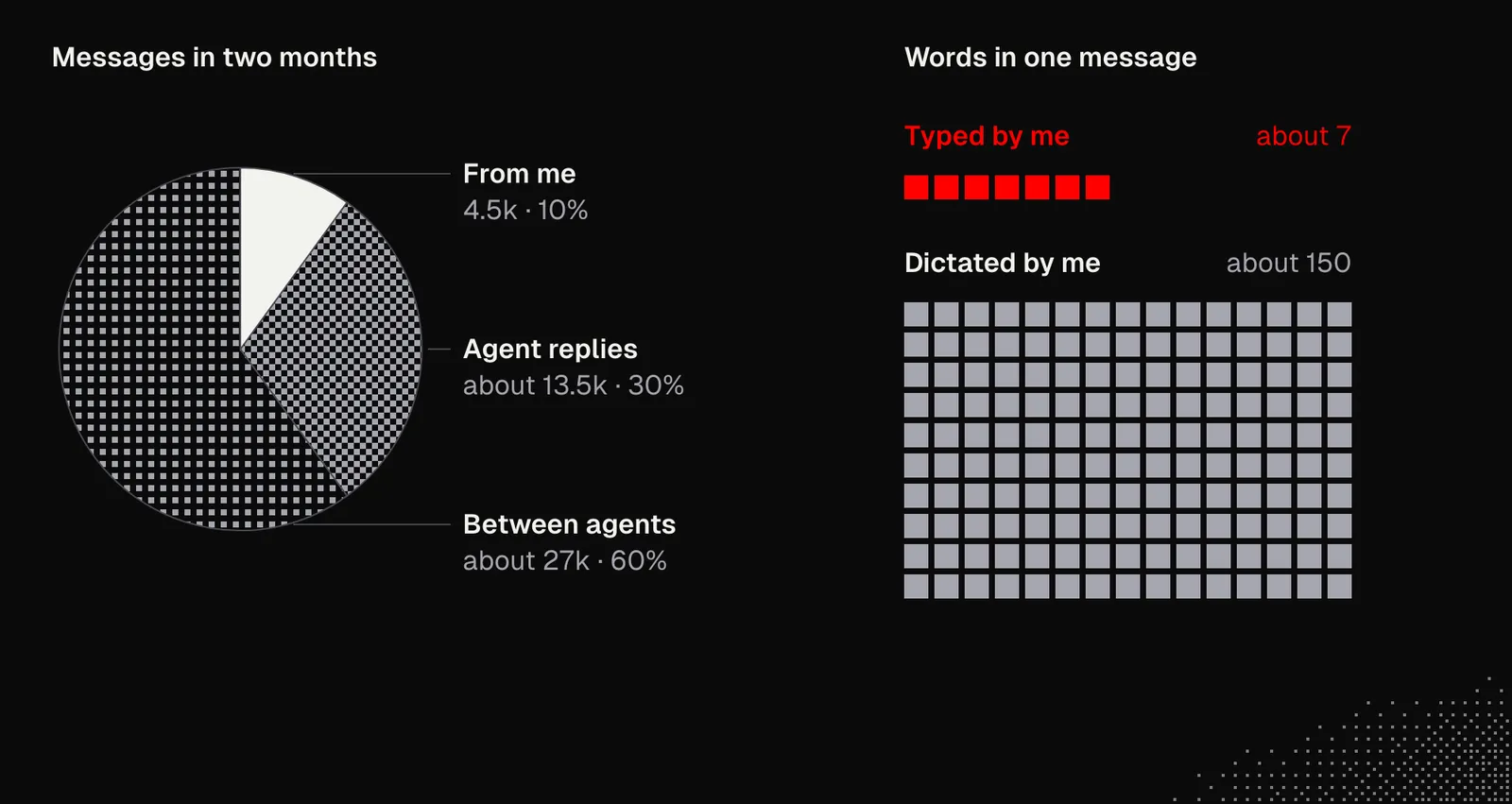
Based on two months of my interactions with agents, my typed messages had about 7 words each, and dictated ones were about 150 words long. And for my 4.5k messages, agents sent me around 13.5k replies and they sent twice as many messages among themselves, without interaction with me, in sessions that lasted from 3 to nearly 40 hours.
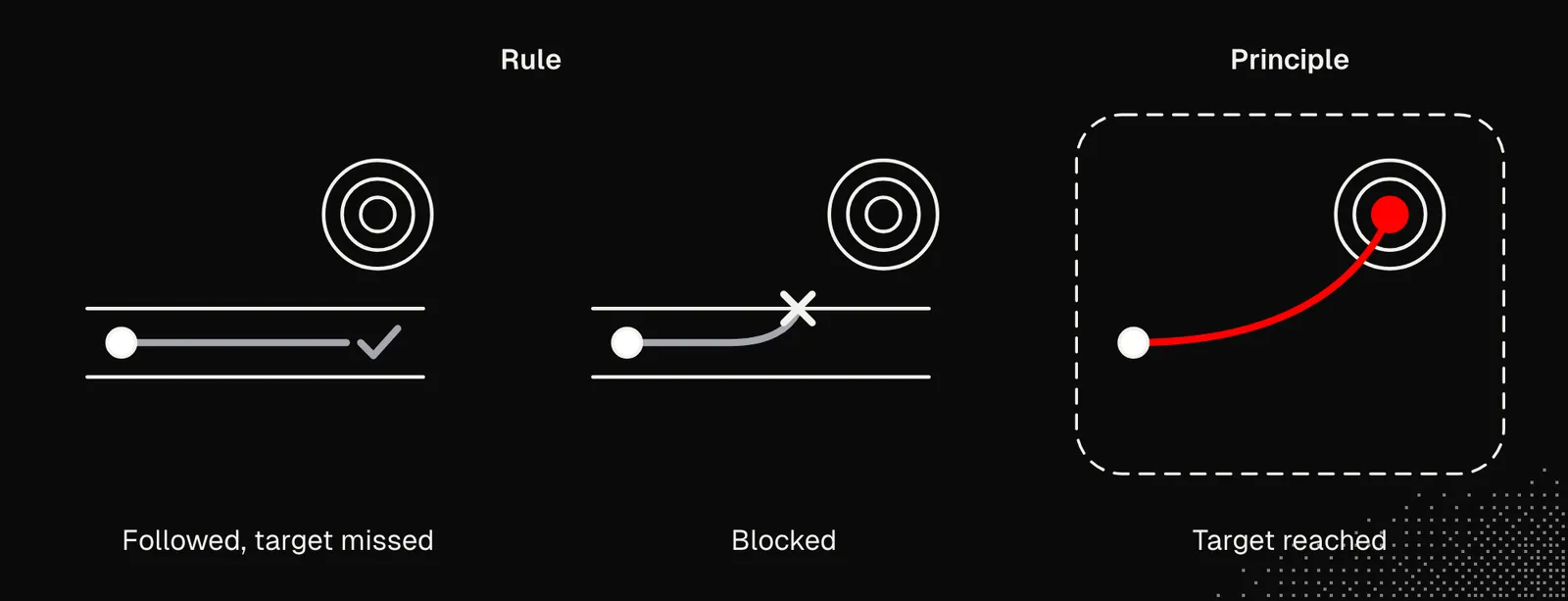
Most of what I do comes down to describing intent and giving feedback. Agents rarely receive exact instructions telling them what to do. In fact, they follow principles, not rules, because it gives them more space to make decisions that would be hard to predict, for example:
Rule: Keep answers under 100 words.
Principle: Respect the reader's attention. Every sentence should earn its place.
Rule: Never delete files.
Principle: Match your caution to the cost of being wrong.
Rule: Use bullet points.
Principle: Let the content decide its form.
Both rules and principles point in the same direction, but the rule may be too strict or too narrow to be useful in the dynamic environment the agent will work in. And models we have today are smart enough to find the best option that remains within boundaries defined by our principles.
Along with principles, it's worth considering telling the agent about the reason behind the intent. This brings an additional layer of valuable context that lets the agent see the bigger picture of what we want to achieve, while still leaving it enough room to steer itself toward the best possible solution. At the same time, the reason helps the agent understand dynamic boundaries that may affect its behavior.
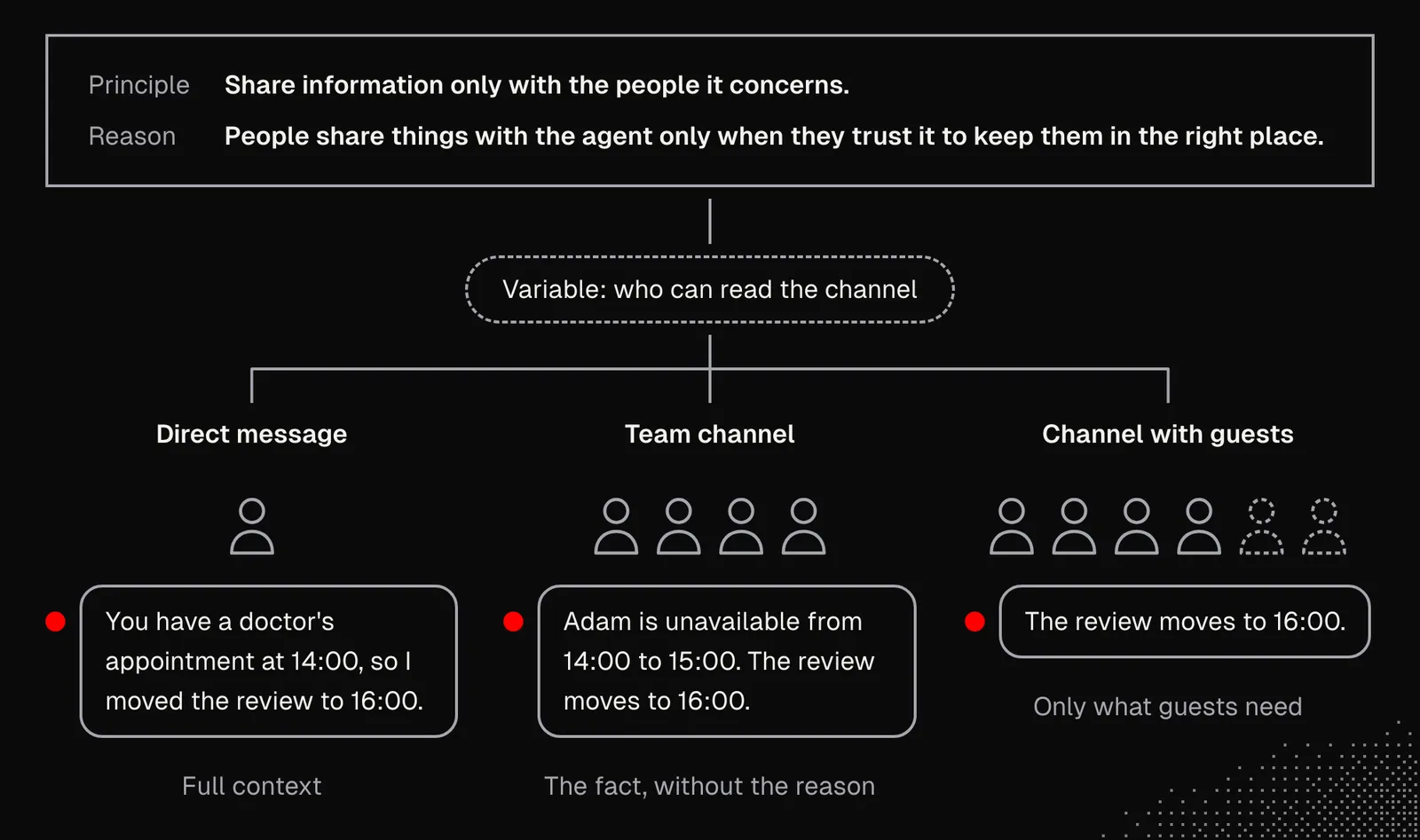
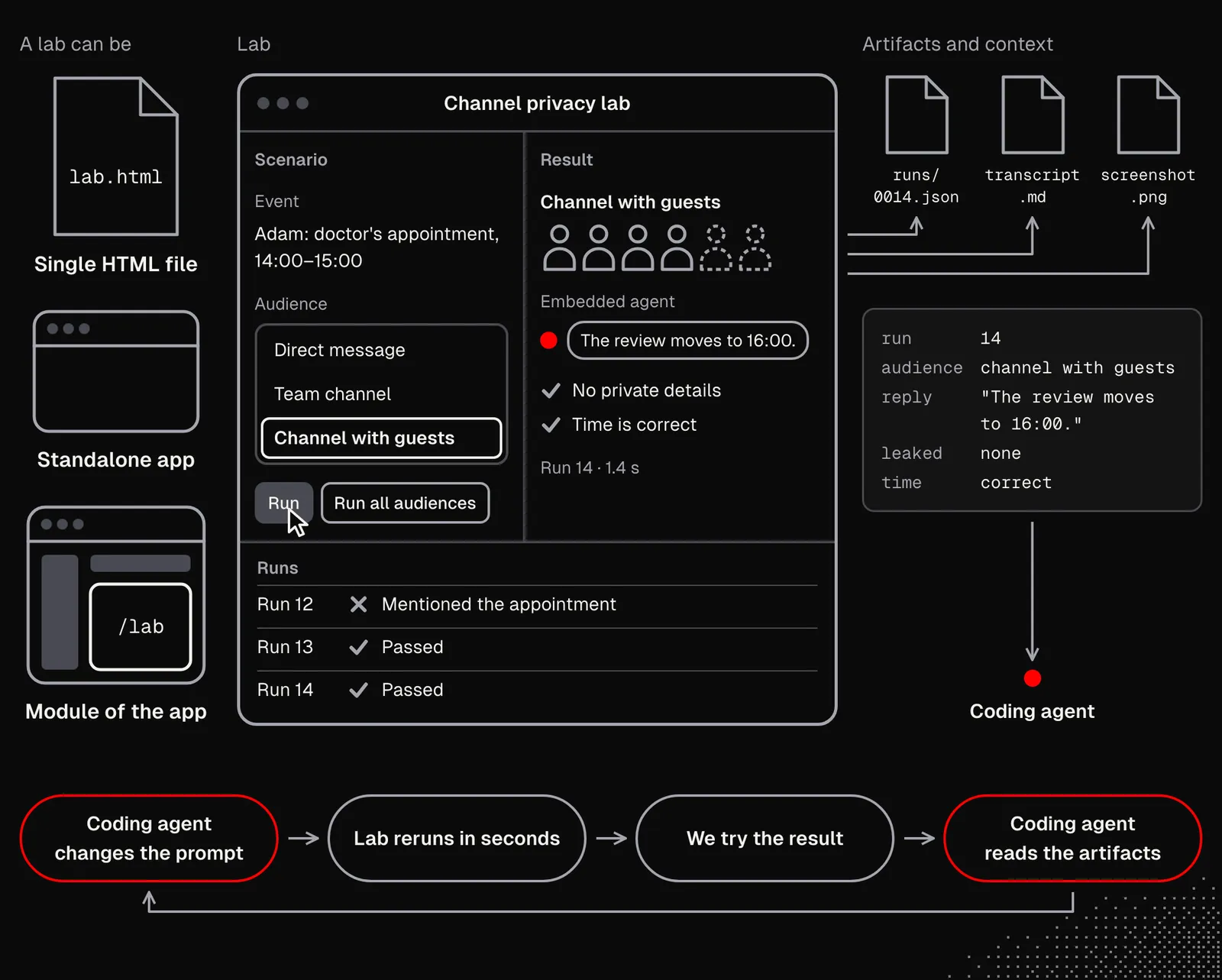
Let's imagine we have an agent with access to context about the people on our team. We want it to communicate openly in direct messages, but not reveal unnecessary details on team channels. So we have:
- Principle: Share information only with the people it concerns.
- Reason: People share things with the agent only when they trust it to keep them in the right place.
In this configuration, we can expect the agent to behave so that direct messages reveal all the details, but the team channel keeps them hidden. And if the agent notices that some channels may have guests from outside the organization, it will adjust accordingly.
And that's just an example, but the main point is that principles and reasons let us shape intents that rely more on models' native capabilities. So the outcome we get may not only match our original requirements but also address aspects we didn't foresee, especially if the agent explores the knowledge base and other available sources.
Product context
Coding agents natively know how to explore a codebase, but they know very little about anything that cannot be read from the code: external services, platforms, tools and internal knowledge bases. What's more, from code alone they can only learn about the current state of a product. They have little idea of its direction, what the team is already working on, or whether there are any strategic business decisions to consider.
Our goal is to make the agent "learn" how to explore context beyond code and how to make decisions that are aligned with product vision and business objectives. The question is: how can we achieve this?
In Kent's repository there's literally a folder named decisions that holds very simple documents that follow the same format, ADR (Architecture Decision Record), and contain information about the decision Kent made, what the context was, and the reason behind it. All those files are entirely managed by agents, but their content comes from interactions with him.
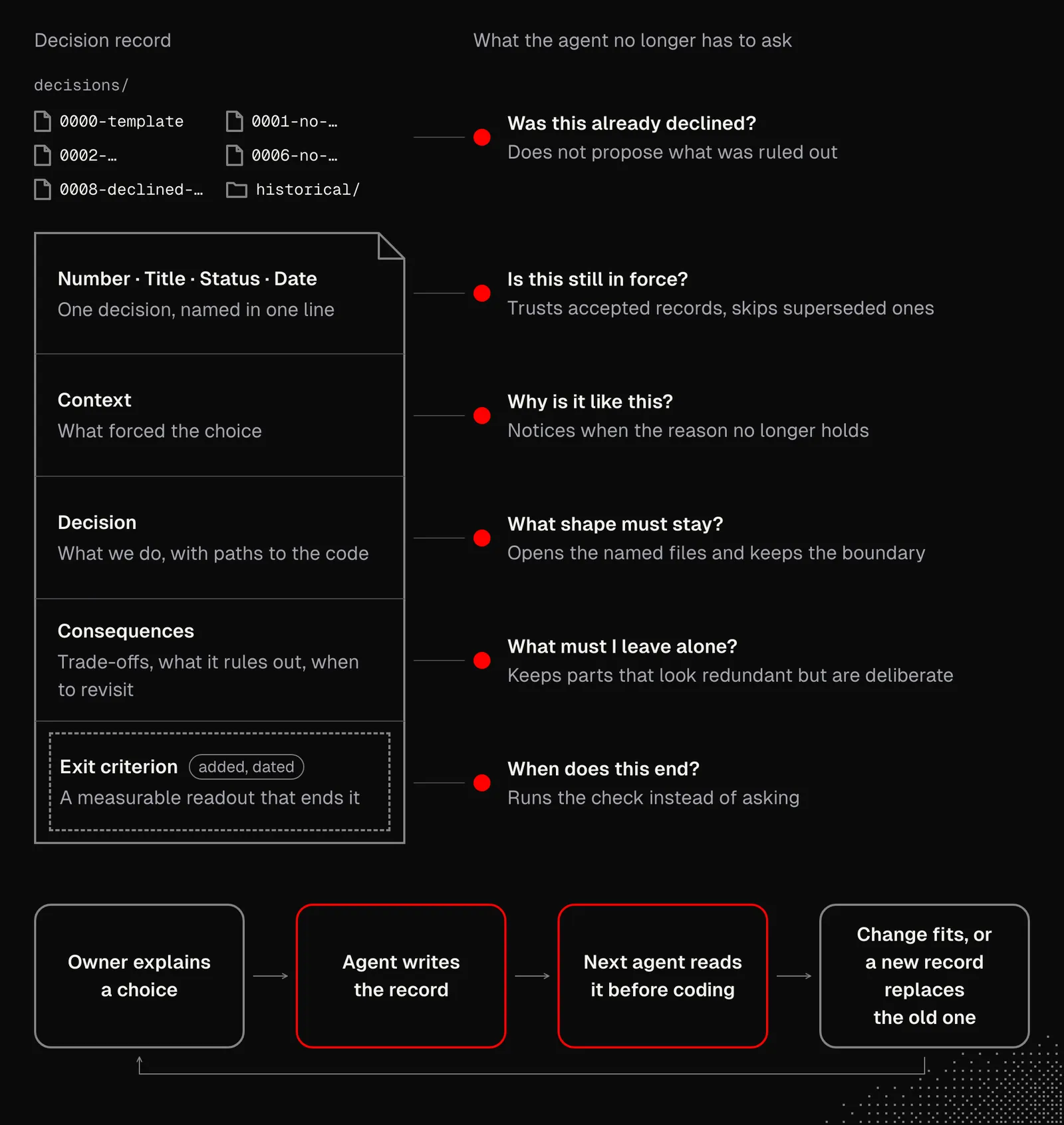
A similar approach comes from our friend Matt Pocock, who says that ADRs work great with /grill-with-docs, a skill that helps with making decisions not only when we work solo on a project, but also within a team. According to him, ADRs help agents better understand changes made earlier and avoid disrupting the work of others. Without ADRs, agents often modify or even remove features that were implemented with a specific intent that can't be inferred from the code alone.
On the other hand, Lauren Tan claims that ADRs don't really work for her because they tend to distract her agents too much. Given the scale of her work (2,500+ PRs a month), it's reasonable that she might have a different perspective. Still, it's worth exploring her approach and its very good breakdown available here. From this we'll learn that her approach is strongly oriented toward principles she turns into durable guidance through skills, types, environment design and self-verification. She avoids feeding agents with a growing archive of past decisions.
And one more example comes from Joel Hooks, who claims that Effect Schemas and heavy Domain-Driven Design (DDD) are how the codebase itself describes the shape of the product. In his project he relies on the "CAFE" stack (Cloudflare, Alchemy, Foldkit and Effect), suggesting it has many traits that make it "agent-first".
All those examples, while different, reveal similar patterns focused on increasing agents' autonomy, which makes them not only ask fewer questions but also make better decisions.
Requirements and decomposition
Agents can do a lot of things autonomously, but most of the requirements still come from the business and clients. It's our job to translate those inputs into the scope of work the agents will take care of, because responsibility is something we can't delegate to AI.
By default, when we think about delegating technical tasks to someone, a detailed specification feels the most natural. But this is not what we're looking for in work with AI agents. A better choice would be to reach an agreement defining scope, outcome, boundaries and proof. AI can help us with all of this, too!
To shape an agreement, we first need to gather as many resources as possible. Not because we want to read them all, but because we want our agents to have more context. This way, we can use not only knowledge that comes from our experience, but also knowledge that goes beyond our current competence. And this process doesn't have to rely on conversation alone. We can also use various "one-off" interactive documents and even mini-apps to make it easier for us to understand what we have, what we want, and whether our agreement reflects this.
Visuals: Since Opus 5.5, models have shown an outstanding ability to represent context visually. One of the best examples is the Anatomy skill, which may not be that useful for our work but perfectly shows what these models are capable of. Another example we may want to try is the /show-me skill from HumanLayer, which was created specifically for visual conversations instead of walls of text.
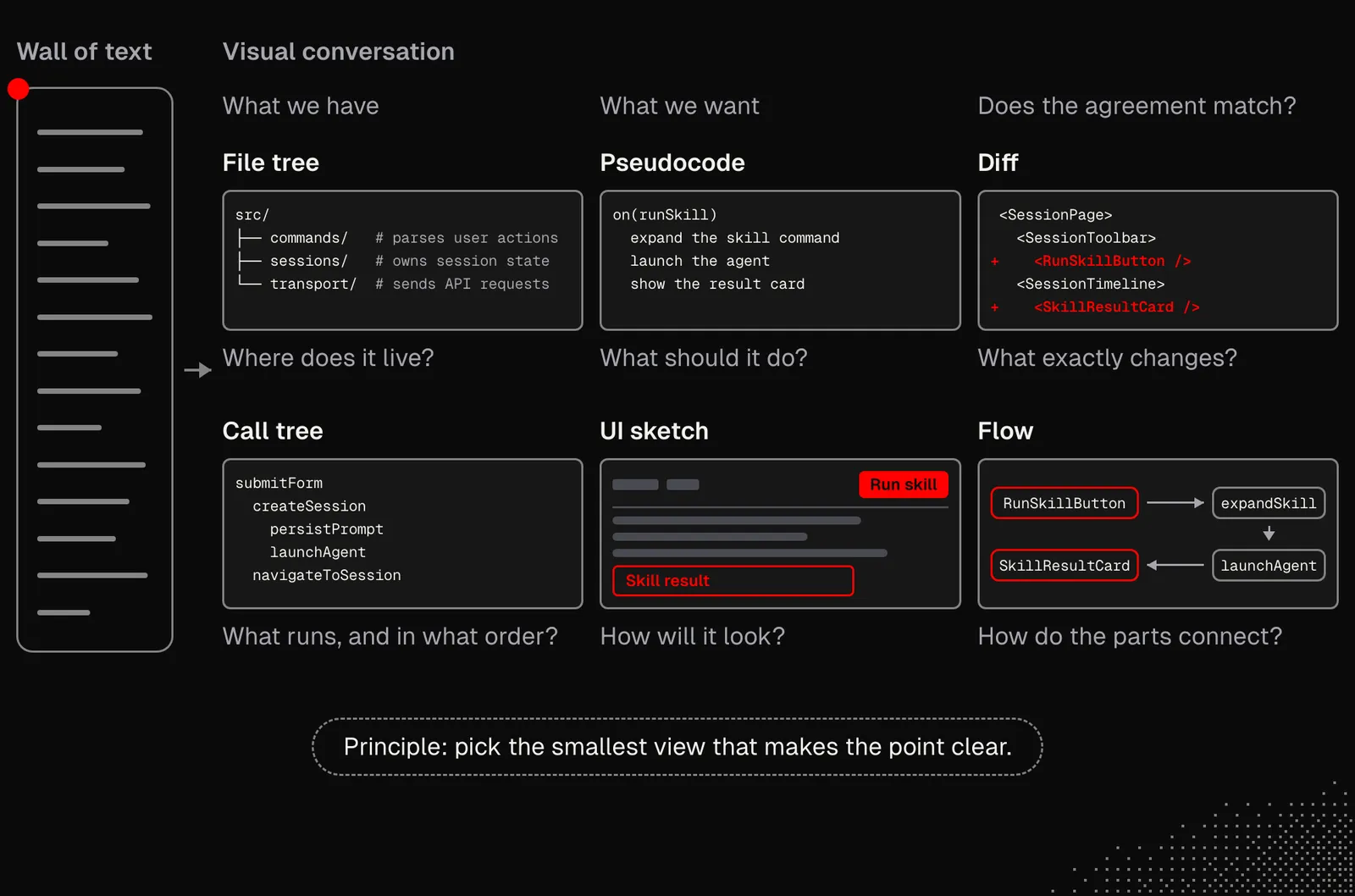
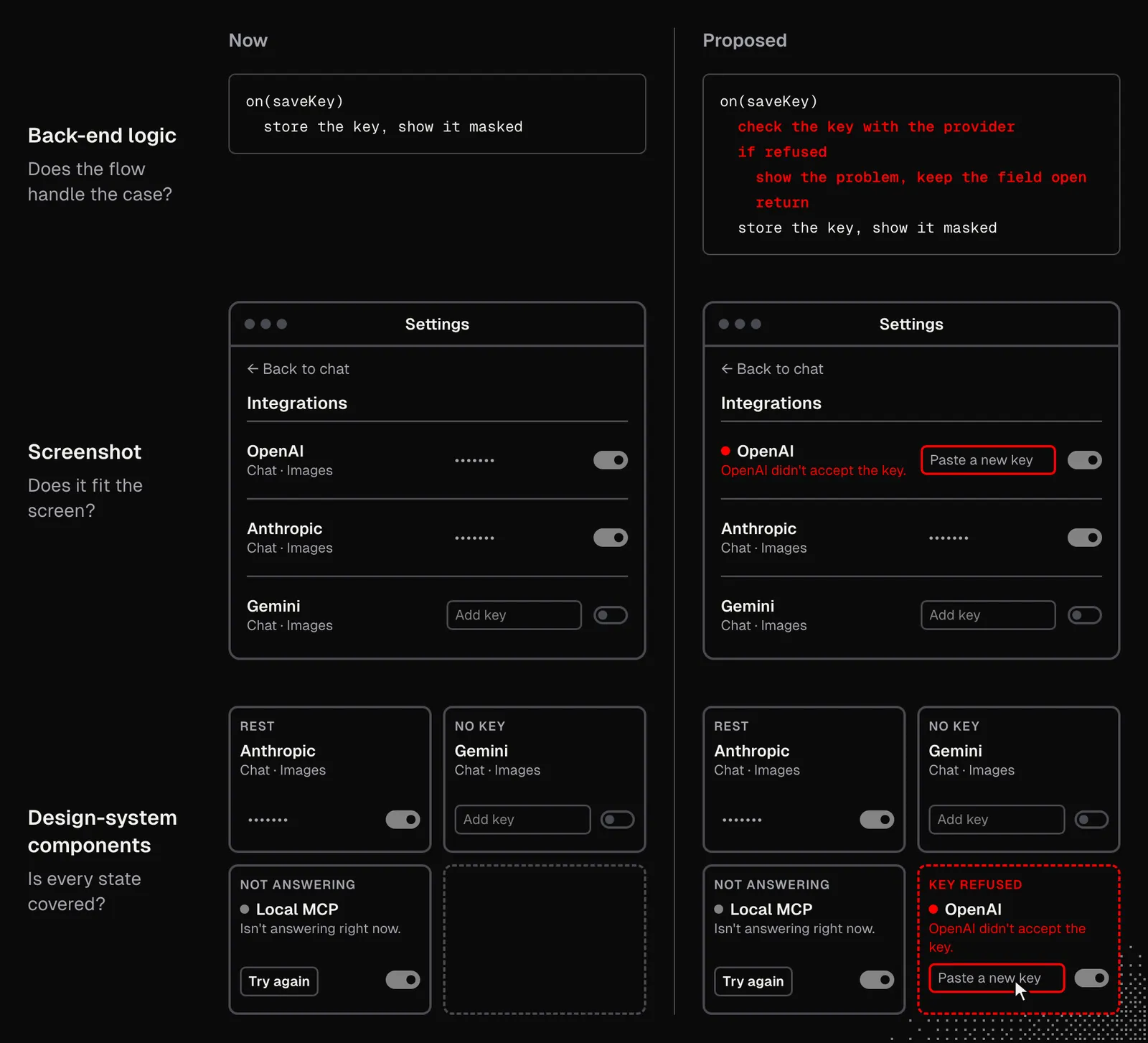
Comparisons: The way to tell whether the change we want to make covers everything we need is to present it as a side-by-side comparison. The comparison may take the form of synthetic visuals of the back-end logic, screenshots of the app, or even actual components generated from the design system or Storybook. One of the examples from my projects shows one of the iterations of the app's settings screen, and it was created based on its design system, so the components are interactive.
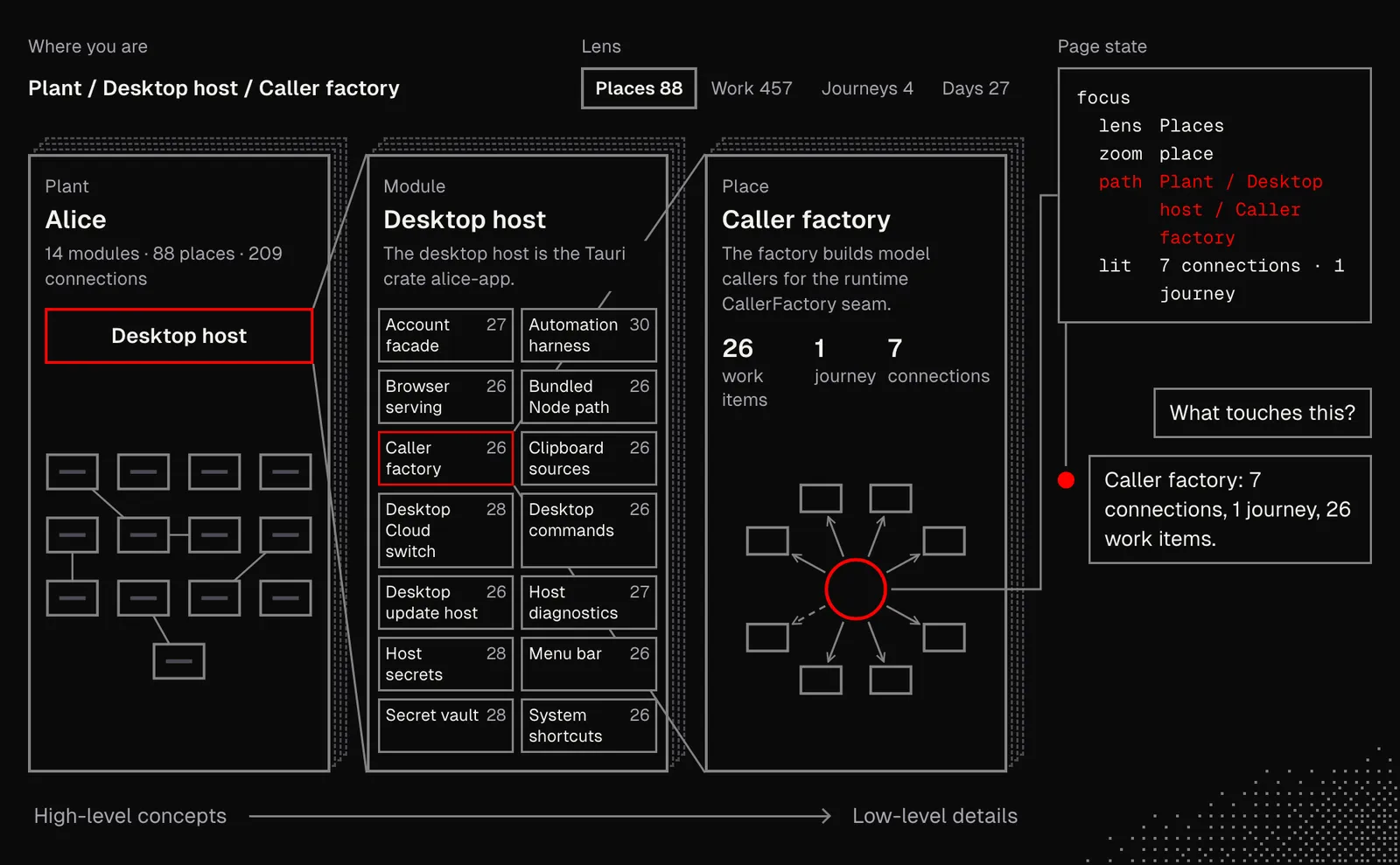
Graphs and diagrams: Reasoning over many documents covering a wide range of topics is easier when we can easily switch between high-level concepts and low-level details. This can be achieved with layered graphs or their variants, built by agents as HTML pages that hold state, so the agent can read it and quickly understand our current focus. Structures like this are best designed by a fleet of agents that will collaboratively work on matching a framework for the graph with the type of data we have. It's worth iterating on the framework a couple of times until its shape is good enough to reuse more than once.
Lab: And lastly, there's the concept of a lab, which can be a single HTML file, a standalone app, or a separate module of the app. A lab is different from the previous forms because it lets us literally experience the results while keeping iterations extremely fast. A lab may also have embedded agents to handle runtime logic and interactions. Labs can be built with an agent-first approach in mind, so agents can get quick feedback from them: a lab may generate artifacts and be a source of useful context.
Regardless of which tool we use, the goal is to discover blind spots, possible edge cases, second-order effects (knock-on effects of the change) and hidden opportunities. This moves us toward systems thinking: instead of looking at a feature or issue in isolation, we want to understand how it connects to the rest of the product. The tools above make the system visible, so that we and our agents can see which parts a change touches, and what it sets in motion, before the work starts.
A tool alone isn't enough to work out a proper agreement, especially because we're not talking about a single, comprehensive plan here, but about a set of tasks. A lead agent will receive them and manage the work of other agents to deliver the results.
We may also use techniques related to generalized steering, mentioned in S01E01, such as self-querying, along with meta-questions and various forms of tree of thoughts. In other words, we should focus on finding ways to steer the agent so that it both loads the model's base knowledge and explores the available context. For example:
- Obvious questions: ask the agent about things we already know to load them into the thread. Then ask it to list modules / features / concepts, and then spin up subagents that will go deeper into them or perform any other transformation useful for the task.
- Rephrasing: turn on the microphone and say everything we know about what we want to achieve. Then ask the agent to rephrase what we just said and enrich its answer with the available context.
- Splitting & merging: when exploring context, don't go straight to the end result. Instead, steer toward broad exploration, then unify the relevant results, and repeat this a couple of times. This is a form of 'tree of thoughts', which we can modify however we like.
- Using mental models: while exploring context, ask the agent to use mental models such as Occam's Razor, First-Principles Thinking, Second-Order Thinking or Inversion. This often improves the quality of the end result.
In simple terms, we need to stay curious and play with the agent to get the results we're happy with. And when we feel comfortable with the process and extract some principles along the way, we may want to let agents self-play.
Evaluation
Reaching agreement on scope, desired outcome, and boundaries is not everything. In fact, the agreement is worthless if the result can't be proven without cheating and without us having to go through every single change. So, we need to build trust by defining how the result will be proven and ensuring the agent has all the tools and the knowledge to prove it.
When defining how the agent's work will be proven, we need to consider:
- Model capabilities: models are great at writing code, using tools and finding patterns in multimodal data. They can also combine these capabilities to test features in dynamic scenarios and gather evidence of their work in the form of logs, measurements, screenshots and videos.
- Model limitations: models struggle with details, keeping track of many variables and instructions, staying consistent and 'aware' of anything that is not currently within their context.
- Resources: running models costs money and time, and requires hardware if evaluation needs to manage processes, compilation, sandboxes or emulation. So it's not in our interest to verify everything, only what really matters.
- Tools we do have: we may have linters, type checkers, compilers, unit tests, development environments, test accounts and even dedicated machines agents can use to run the tests.
- Tools we do need: if anything prevents the agent from verifying its own work, we first need to design and generate tools for it to use. This may include configuring test environments or even machines using platforms such as agentcomputer or Browserbase.
- Metrics: evaluation needs metrics and evidence that accurately reflect reality. For example, when testing a UI, having an LLM analyze screenshots isn't enough because it struggles to see the details, so measurements need to be taken in code. Also, if the feature affects the database, the records' mutation history may reveal potential issues.
- Definition of success: the agent must know what success means to us, because without that definition, the agent may push too far or not far enough. Good examples of going too far are feature flags, backfills, or security features that agents often build by default because they aren't aware that these features are irrelevant in the broader context of the product.
- Definition of failure: the agent must know when the gathered evidence, despite its good quality, should count as a failure. The fact that this often depends on context makes it hard to guess.
Doing all this is difficult and takes a lot of resources, not only to build but also to repeat. That's why part of this process has to be dedicated to extracting generalized tools and skills that can be reused. Even more importantly, anything that can be verified deterministically should be handled through code, unless we have a solid reason to do otherwise.
Takeaways
Today, translating intent into agent work isn't about telling the agent exactly what to do, but about expanding its tool stack and its "understanding," and adjusting its environment, while also using the model's knowledge and native agentic capabilities to do this.
Doing all this is hard because agents are limited in many ways, their contact with the environment is constrained, and many factors beyond code need to be considered to get the right work done, and done right. Moreover, we need to manage pace, quality, scale, progress and our own energy.
Looking at this, we can clearly see that programming as we knew it isn't here anymore. But at the same time, many of these "new challenges" are ones we engineers have known for years. And when we look at the possibilities AI opens up for us, it becomes clear that there's a lot of work to be done, many challenges to take on and barriers to overcome, and that's where the joy and satisfaction we've known for years come from.